

Cart
0
You've decided to buy a proper riding jacket. Good call.
But then you open a browser, and suddenly you're drowning in specs — denier counts, CE levels, EN numbers, mesh vs. textile, PU foam vs viscoelastic foam. It feels like you need an engineering degree just to buy a jacket.
You don't. This guide will walk you through everything that actually matters, in plain language, so you can make a decision you won't regret on the road.
------------------------------------------------------------
First: Understand What a Riding Jacket Is Actually Doing
A riding jacket has one job before anything else — to keep your skin on your body if you go down.
When you fall off a motorcycle, two things happen almost simultaneously. You hit the ground (impact) and then you slide across it (abrasion). A good riding jacket handles both. Everything else—the vents, the pockets, the fit — is secondary to those two functions.
Keep this in mind as you read the rest of this guide. Every spec we discuss connects back to one of those two jobs.
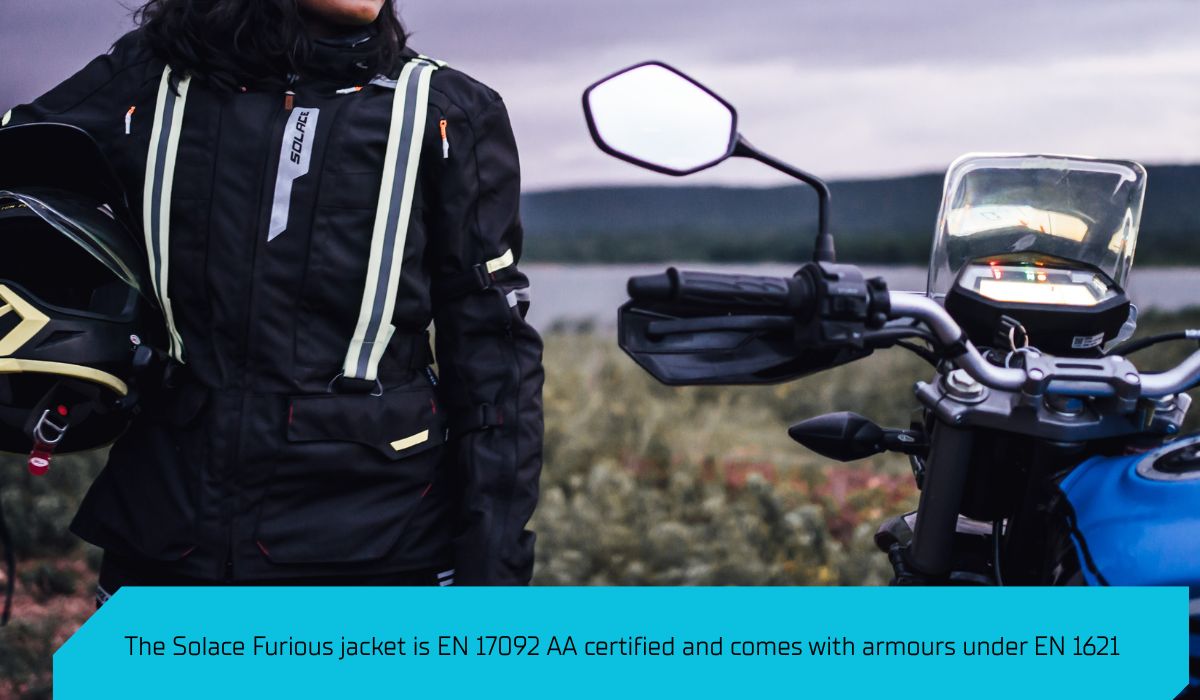
Do remember that EN 17092 related abrasion tests for the fabric and EN 1621 tests for the armor both are separate, and you should check both along with armor coverage while selecting a jacket.
A jacket having AA can have CE Level 1 armor and a jacket having A can have good quality CE Level 2 armor. There are more nuances to this, and we shall cover it in a separate blog.
------------------------------------------------------------
Part 1: The Shell Fabric — Your First Line of Defense Against the Road
The shell is the outer layer of the jacket. It's what meets the tarmac when you slide. The material it's made from determines how long it holds together before wearing through.
Leather
Leather is the oldest riding material for a reason — it's exceptionally good at resisting abrasion. Cowhide, buffalo, and kangaroo leather all perform differently, but as a category, leather offers some of the best slide resistance you can get.
The trade-off? Heat. Leather doesn't breathe so well. In Indian summers, a full leather jacket on a long ride is a serious commitment. It's also heavier, requires maintenance, and doesn't handle rain well.
Leather is the right call for track riders, sport bike riders doing spirited riding, and anyone who prioritizes protection over comfort in all conditions.
Textile
Textile jackets use synthetic fabrics — typically nylon or polyester — woven at high density. The number you see attached to these fabrics is called a Denier rating, and it tells you how thick the fibers are.
A higher denier means thicker fibers, which generally means more abrasion resistance.
-
300–500D: Entry-level. Fine for city commuting at lower speeds.
-
500–900D: Mid-range. A solid choice for highway touring and mixed riding.
-
900D+: High-tenacity performance fabrics.
Some jackets use reinforced panels of Superfabric™ , Cordura™ , or Kevlar™ in high-abrasion zones — the shoulders and the elbows. If you see these call-outs, pay attention to where they're used, not just that they're present, and their Denier if available.
For Indian riding conditions — the heat, the varying road surfaces, the long highway distances — a good quality textile jacket is often the most practical choice for most riders. It breathes better, handles rain better, and is easier to live with daily.
Mesh
Mesh jackets are essentially textile jackets with large ventilation holes built into the fabric. The airflow is excellent, which makes them popular for Indian summers.
The honest trade-off: those holes reduce abrasion resistance. Mesh jackets are better than riding in a t-shirt — significantly better — but they sit lower on the protection spectrum than a solid textile or leather jacket.
If you ride in intense heat and do mostly city or moderate-speed riding, mesh with proper armor is still a solid step up. Just go in with clear eyes about what you're trading.
---
The Hybrid Approach: When One Fabric Isn't the Whole Answer
Most serious riding jackets today don't use a single fabric throughout. They use two — and where each material sits on the jacket is as important as what the material is.
Textile + Mesh
The most common hybrid construction for Indian conditions. The logic is straightforward: high-abrasion zones like the shoulders, elbows, and the side torso use solid high-denier textile, while the chest, median of arms and back body use large mesh panels for airflow.
You get the abrasion resistance where you actually need it — the zones that contact the road in a fall — and you get the ventilation everywhere else. It's a more considered design than a pure textile or pure mesh jacket, and for most Indian riders doing a mix of city and highway riding, it hits the right balance.
What to check: make sure the mesh panels don't sit over the armor zones. Mesh directly over an armor pocket is fine — the armor does its job regardless. Mesh as the primary material in a shoulder or elbow strike zone is a different story, unless the mesh itself is high tenacity and proven by an EN 17092 score or other abrasion tests.
Leather + Mesh
This construction takes the abrasion performance of leather and pairs it with mesh panels — usually across the back torso and sides — to address leather's biggest real-world weakness in Indian conditions: heat.
The result is a jacket that performs closer to full leather in a slide but is actually wearable. The leather panels typically cover the shoulders, forearms, and elbows — the strike zones — while the mesh opens up the areas that don't hit the road but do trap heat.
It's a premium construction and reflects in the price, but for a rider who wants leather-grade protection without committing to full leather's thermal penalty, it's the most honest compromise available.
What to check: the quality of the leather panels matters here more than in a full leather jacket. Look for the hide type called out explicitly — cowhide, buffalo, and kangaroo each have different thickness-to-weight ratios and abrasion performance, also look for full grain, top grain or perforated leather. A leather-mesh jacket with thin, unspecified leather in the critical zones isn't delivering the protection the construction implies.
The Old Standard vs. The New One
The newly introduced EN 17092:2020 standard, enacted in 2020, replaces EN 13595 and implements a new five-class protection system designed to accommodate the various riding styles we use—from urban commuting to touring and sport—while ensuring a significant safety baseline for the abrasion tests.
The Five Classes — Breaking Down the Letters
EN 17092 introduces five protection classes, ranging from the least protective (Class C) to the most robust (Class AAA). Here’s what these classes really signify:
-
Class C: Offers no inherent abrasion resistance. Designed solely to hold impact armor in place; must be worn over a CE-approved jacket for full protection. This class includes many mesh armored layers and airbag vests.
-
Class B: Provides abrasion resistance but lacks dedicated impact protection zones. Basic safety—generally for low-speed urban use.
-
Class A: Meets the baseline protection levels for both impact and abrasion. Entry-level and lightweight summer mesh jackets usually fit here.
-
Class AA: Offers significantly enhanced protection from impact and abrasion, utilizing materials that satisfy higher standards than Class A. Most mid-range textile and leather jackets belong in this category.
-
Class AAA: Represents the pinnacle of protection. Designed for challenging riding conditions, passing tests at the highest abrasion standards while providing maximum impact shielding. Typically found in full leather or high-spec textile suits.

------------------------------------------------------------
Part 2: The armor — What Protects Your Body at Impact
Your shell handles the slide. Your armor handles the hit.
When you go down, your elbows, shoulders, chest and back are the zones that absorb concentrated impact energy. Armor inserts sit over these zones and are designed to absorb and distribute that energy.
What is CE Certification?
CE certification is the European safety standard for protective gear. For armor inserts, the relevant standard is EN 1621.
There are two levels:
-
CE Level 1: The insert absorbs impact below 35kN of transmitted force. Adequate protection for most riding. (for limbs)
-
CE Level 2: The insert absorbs impact below 20kN of transmitted force. Significantly better energy absorption. The standard you want if protection is a priority. (for limbs)
When a brand says their jacket has "CE certified" armor, ask specifically: Level 1 or Level 2? And which zones?
A jacket can have Level 1 shoulders and elbows and no back protector and still technically have CE armor. The details matter. More importantly, a jacket can have AA certification and still skimp out on the armor, or may not even include a chest and back protector.
The Zones to Check
Shoulders and Elbows These are the most common impact zones in a fall. All serious riding jackets will have armor here. Check the CE level — Level 2 is meaningfully better.
Back The spine is irreplaceable. Many jackets include a basic foam back pad, which offers minimal protection. Others include a CE-rated back protector. Some jackets come with a pocket but no protector included, expecting you to buy one separately.
This is one of the most important things to check. If the jacket doesn't come with a CE-rated back protector, budget for one when you're calculating the total cost.
Chest Less commonly included but increasingly seen in better jackets. The chest houses your sternum and ribs — a chest protector adds meaningful protection for front impacts. Not universal, but a genuine plus if present.
Armor Materials — What's Inside Actually Matters
Not all CE-rated armor is equal in real-world use.
Foam armor is the most common. It's cheap to produce and meets CE standards, but it's bulky and can feel stiff and uncomfortable.
Viscoelastic / rate-sensitive armor (the category that includes brands like D3O and SAS-TEC is softer and more flexible at rest but stiffens on impact. It's more comfortable to wear daily and conforms better to your body. If you're doing long trips, this makes a real difference.
More on the armor in a blog later.
------------------------------------------------------------
Part 3: The Fit — Because None of This Works if the armor Moves
Here's the part most buyers underestimate: armor has to stay in position during a crash to protect you.
If your jacket is too loose, the armor shifts. Your elbow padding ends up over your forearm. Your shoulder protection rotates out of place. You've paid for protection that isn't where it needs to be when you need it.
When you try on a riding jacket:
Sit in your riding position, not just stand upright. Lean forward like you're on the bike. The sleeves should stay long enough to cover your wrists. The back should stay tucked in. The jacket should pull forward at the waist rather than riding up.
Check the armor placement in riding position. Shoulder pads should sit directly over the shoulder joint. Elbow pads should sit over the elbow, not above it. A jacket that fits perfectly standing up can be a size too big once you're in position on the bike.
Adjustment systems matter. Waist straps, sleeve adjusters, and cuff closures help dial in the fit. More adjustment points mean the jacket can accommodate your specific proportions rather than relying on you fitting a generic template exactly.
------------------------------------------------------------
Part 4: Ventilation — The Practical Reality of Indian Riding
This doesn't affect protection, but it determines whether you'll actually wear the jacket.
The best protective jacket in the world doesn't help you if you leave it at home because it's too hot.
We have already explained you the textile+mesh hybrid jacket, but when buying a textile touring jacket, look for:
-
Chest and back vents that open and close — so you can seal them in cold/rain and open them in heat.
-
Underarm vents (called pit zips on some jackets) — very effective at channelling airflow through the torso.
-
Mesh liner panels inside the jacket that allow air to move across your skin even when the outer shell is solid textile.
For highway riding in Indian summers, ventilation is not a luxury feature. It's what keeps you alert and comfortable over long distances.
Part 5: The Liner System
Most riding jackets come with a removable thermal liner — a quilted inner layer that clips or zips in for cold weather and comes out for warmer conditions, or a separate thermal jacket like ours.
This matters more than it sounds. A jacket with a good liner system is genuinely a year-round piece of kit. Without it, you're buying something seasonal.
Others come with a rainproof liner that goes above or under the jacket. Personally, we at Solace prefer an external rain liner since its easy to get off and on in case the rain stops, and it also keeps your jacket safer from mud splashes.
Look for the water resistance rating on the fabric of the rainproof liner and the fill rating for the thermal liner.
------------------------------------------------------------
The Honest Summary: What to Actually Look For
When you're standing in a store or reading a product page, here's your checklist:
Shell
-
What fabric? What denier?
-
Does the jacket pass EN 17092 ? Do remember that this is not mandatory in India.
-
Does it have jacket to pant connection zipper?
-
Are high-abrasion zones (shoulders, elbows) reinforced?
Armor
-
CE Level 1 or Level 2 at shoulders and elbows?
-
Does it include a back protector — and is it CE-rated?
-
Is the armor material comfortable enough that you'll leave it in?
Fit
-
Does it fit in riding position, not just standing?
-
Does the jacket have quality zippers like YKK™ brand or others ?
-
Are there adjustment systems to dial in the fit?
Livability
-
Ventilation adequate for the conditions you ride in?
-
Does the jacket get reflective stickering or panels?
-
Removable liner for year-round use?
------------------------------------------------------------
What we use at Solace
We have been manufacturing jackets and gear since more than a decade. These are some of the highlights you will find in our product range -
-
High Denier fabrics usually 600d or above.
-
High tenacity mesh zones.
-
Jackets with both the liner systems and/or either / without it.
-
Jackets that pass EN 17092 abrasion test norms.
-
Armors from global brands like SafeTech, Powertector, SAS-TEC and our own home grown Soter Armor.
-
Genuine YKK™ zippers and advanced fabrics like Cordura™, SuperFabric™, etc
-
Jackets in a varying price point and segments like office-going subtle designs and multi-panel technical touring jackets.
-
Jacket to pant connection zippers.
------------------------------------------------------------
A Final Note
The goal isn't to buy the most expensive jacket on the shelf. The goal is to buy a jacket you understand — where you know what each feature does and why it's there.
When you understand what you're wearing and why, you wear it every ride. And that's the only way any of this protection actually works.
Ride safe.
At Solace, we make riding gear for Indian conditions — built around the roads we know and the varying climatic conditions we ride through.


