

Cart
0
You're standing in a gear store – or scrolling through a gear website – and you're staring at a wall of gloves. Some look like they belong on a racetrack. Some look like winter gloves. Some cost ₹800 and some cost ₹8000. And nobody has clearly explained what the difference actually is.
This guide will.
We'll keep it simple. By the end, you'll know exactly what to look for and why — so you can pick the right pair of riding gloves without second-guessing yourself.
Why Riding Gloves Are Not Optional
When you fall off a motorcycle — at any speed — your hands go out first. It's instinct. You can't override it.
At 40kmph, bare skin on tarmac will abrade through in a fraction of a second. At highway speeds, the damage is significantly worse. Your palms, knuckles, and the pinky side of your hand all make contact with the road before almost anything else.
A good pair of riding gloves does three things:
-
Protects your palms from abrasion during a slide
-
Protects your knuckles and fingers from impact
-
Protects your wrist from bending the wrong way
A pair of regular gloves, fashion leather gloves, or workout gloves does none of these things effectively. They look similar. They are not the same.
Part 1: The Material — What Your Gloves Are Made From
The outer material of a riding glove determines how well it holds up when it meets the road. Different materials have different strengths, and understanding them helps you pick what suits your riding.
Full Leather Gloves
Leather is the oldest and most proven riding material. It offers excellent abrasion resistance — it holds together under friction better than most synthetic alternatives.
The most common leathers used in riding gloves:
Cowhide — The most widely used leather in riding gear. Durable, relatively affordable, and widely available.
Goat Leather — Softer and more supple than cowhide. It molds to your hand faster and offers better feel on the controls.
Kangaroo Leather — The most abrasion-resistant natural leather by weight. Kangaroo hide is tougher than cowhide at a fraction of the thickness, which means better protection without bulk. Found in premium gloves. If you see it called out on a palm, it's a genuine performance advantage.
Full leather gloves are a great all-round choice. They breathe reasonably well, look clean, and perform well in a crash. The limitation is heat — in peak Indian summer, full leather can get warm on long rides.
Fabric / Textile Gloves
Textile gloves use synthetic materials — typically nylon, microfiber or polyester — for the chassis. They're lighter, often more breathable, and easier to care for than leather.
The tradeoff is abrasion resistance. Textile doesn't hold up to a slide as well as leather, though high-denier fabrics and reinforced panels close the gap significantly at the palm and knuckle zones.
Textile gloves are popular for commuting, touring, and riding in hot weather.
Hybrid: Leather + Mesh
This is the most popular construction for Indian riding conditions — and for good reason.
The idea is simple: put leather where it matters most (palm, knuckles, pinky side) and use mesh panels everywhere else for airflow. You get meaningful abrasion resistance in the zones that hit the road, and ventilation across the back of the hand and between the fingers where you just need comfort.
If you're a new rider looking for an all-purpose glove that handles a Bangalore commute and a weekend highway run equally well, a leather-palm mesh-back hybrids like the Solace Rival, Vento and Rover make a lot of sense.

Part 2: The Palm — The Most Important Zone on Any Glove
Most riders look at the back of a glove first. The knuckle protector is visible, the branding is there, it looks aggressive and protective.
Flip the glove over. The palm is where the real engineering sits.
In a fall, your palm hits the road first and takes the most sustained abrasion. If the palm material wears through, your skin is next.
What Makes a Good Palm
Leather reinforcement — Even on textile or mesh gloves, the palm should be reinforced leather. Kangaroo leather on the palm of a mesh glove is a genuinely useful feature — not just marketing.
Double or triple stitching — The seams on the palm take stress in a crash. Single-stitched seams can pull apart. Look for reinforced stitching in the palm zone.
Superfabric panels — Superfabric is a hard-plate composite material bonded to a fabric carrier. It's extremely abrasion-resistant and increasingly common on the pinky finger — the zones that contact the road before the centre of the palm in a low-side. If a glove calls out Superfabric, check where it's placed. Pinky and palm coverage is the most valuable location.
-------------------------------------------------------------------------------
Part 3: Palm Sliders — The Feature That Protects Your Wrist Bone
This one doesn't get talked about enough, so let's give it its own section.
When your palm hits the road, one of two things can happen:
-
The leather grips the tarmac, your hand stops dead, and your body weight continues forward — loading all that force through your wrist into the scaphoid bone. The scaphoid is a small bone, and it breaks.
-
A slider on the palm allows your hand to travel forward on impact, distributing the force and reducing the load on your wrist.
Palm sliders are the difference between those two outcomes.
Types of Palm Sliders
Soft sliders — Usually a rubber or TPU patch on the base of the palm. Good for dirt or off-the-tarmac riding.
Hard plastic sliders — A rigid plastic or nylon insert on the palm base. More effective at initiating and maintaining a slide on impact. Common on mid-range performance gloves.
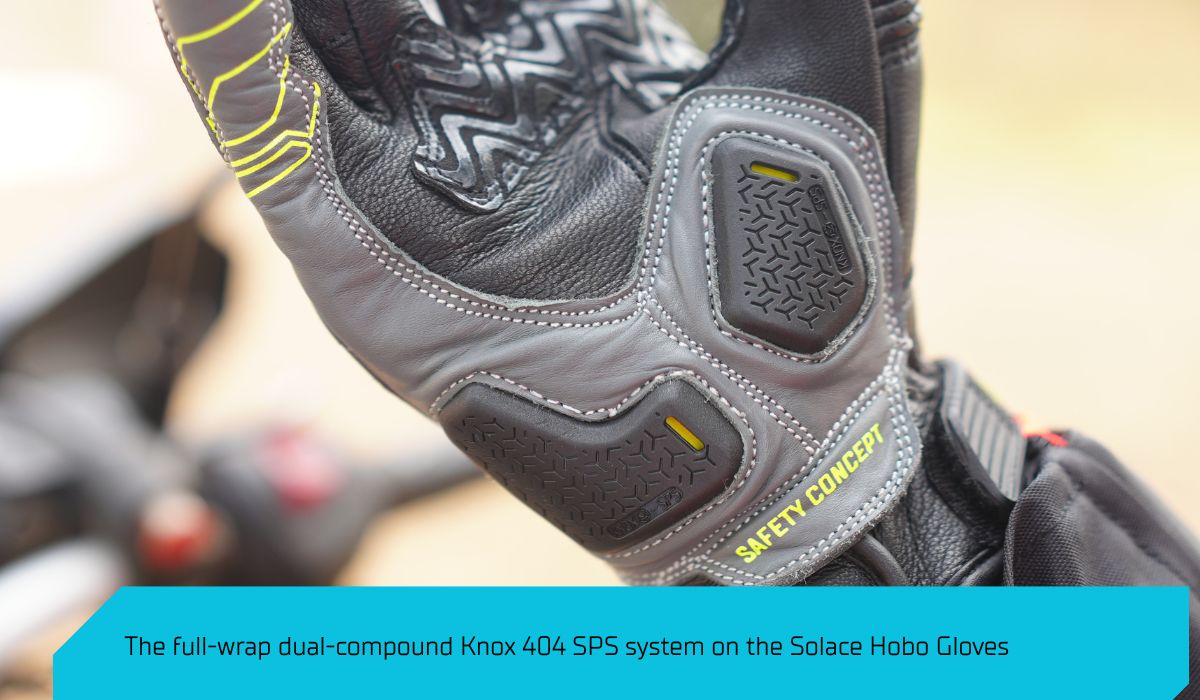
Knox SPS sliders — Knox is a specialist British protection company. Their SPS (Scaphoid Protection System) uses a specifically engineered hard slider that wraps the base of the palm in a fuller coverage area. It's one of the most thoroughly tested slider systems available, and it's what you'll find on gloves like the Solace Furious V3.0 CE and the Rival CE. If a glove specifies Knox SPS, it's a meaningful callout — not just a badge.
If protection is a priority, look for a glove that names the slider system and explains what it does. "Palm slider" as a vague feature is less useful than a brand or specification behind it.
------------------------------------------------------------------------------
Part 4: Knuckle Protection — What's Actually Covering Your Hand
The back of your hand, particularly the knuckle area, takes impact in a forward fall. Knuckle protection is the most visible armor element on a glove, but visibility doesn't always equal quality.
What to Look For
Hard shell knuckle protector — A rigid outer shell, usually TPU or hard plastic, over a foam backing. The hard shell distributes the impact across a larger area before the foam absorbs it. This two-layer system is significantly more effective than foam alone.
Soft shell knuckle protector – Armor brands often use protection from brands like SAS-TEC and ImpactOn. These are viscoelastic or PU protectors wrapped inside a leather panel, usually.
CE Level 1 vs CE Level 2 — More on CE ratings in the next section, but for knuckles specifically: CE Level 2 absorbs significantly more impact energy than Level 1. On gloves where you'll be spending money on protection, the knuckle CE level is worth checking. It is marked as KP under the CE badge.
Finger protection — Beyond the main knuckle, look at whether the glove has any protection along the fingers themselves. Segmented finger armor or reinforced finger seams add meaningful protection. The pinky finger in particular is vulnerable — it's often the first finger to contact the road in a low-side.
-------------------------------------------------------------------------------
Part 5: CE Ratings for Gloves — What the Numbers Mean
CE certification for gloves falls under EN 13594:2015 — the European standard for motorcycle rider hand protection.
Unlike jacket armor which rates individual inserts, glove CE certification rates the entire glove as a system. There are two levels:
Level 1 — The glove meets minimum impact and abrasion resistance requirements. Adequate for general riding.
Level 2 — Higher performance across impact absorption and abrasion resistance. The standard serious riders look for.
At Solace Gears, many of our gloves carry CE certification — it's not just a sticker; it reflects tested, verified performance.
-------------------------------------------------------------------------------
Part 6: Gauntlet vs. Short Cuff — Which One Do You Need?
This is one of the first decisions you'll face when choosing gloves, and it comes down to a simple tradeoff: protection vs. convenience.
Short Cuff Gloves
Short cuff gloves end at or just past the wrist. They're easy to put on and take off, look cleaner, and are more comfortable in heat.
The gap they leave — between the glove cuff and your jacket sleeve — is a real vulnerability. In a fall, that gap can expose your wrist. At lower speeds and for casual riding, many riders accept this tradeoff.
Gauntlet Gloves
Gauntlet gloves extend several inches past the wrist and are designed to strap over your jacket cuff. This eliminates the gap entirely — your jacket and glove overlap and the wrist is fully covered.
They're harder to put on, slightly warmer, and bulkier. But for highway riding, adventure touring, long trips, or anyone prioritizing protection over convenience, gauntlets are the right choice.
Our honest recommendation for new riders: start with gauntlets. You don't yet have a feel for exactly what you're trading when you choose short cuff. Once you've ridden more and understand your style and risk tolerance, make an informed switch if it suits you. If the budget is an issue, try to get short cuff gloves with full grain leather and a hard slider on the palm at the very least.
-----------------------------------------------------------------------------
Quick Reference: What to Check When Buying
When you're looking at any glove, run through this:
Palm
-
What material? Leather type specified?
-
Is there a palm slider? What kind?
-
Superfabric on pinky ?
Knuckles & Fingers
-
Hard shell or soft shell?
-
CE certified under KP ?
-
Any finger reinforcement?
Wrist
-
Short cuff or gauntlet?
-
If gauntlet — does it close securely over a jacket cuff?
Overall
-
CE EN 13594 certified as a glove?
-
What level?
The Bottom Line
Gloves are the easiest piece of gear to underestimate — they're small, they seem simple, and it's tempting to grab the cheapest pair that looks the part.
But your hands go out first, every time. The difference between a glove with a Knox SPS slider, CE certification, and good quality leather on the palm, and a fashion glove with a rubber patch, is the difference between a scaphoid fracture and riding home the same day.
Buy gloves with the same seriousness you bring to buying a helmet. Your hands will carry you through every ride — they deserve proper protection.
At Solace, we work a lot on making the gear functional. Browse our CE-certified glove range at solacegears.com


