

Cart
0
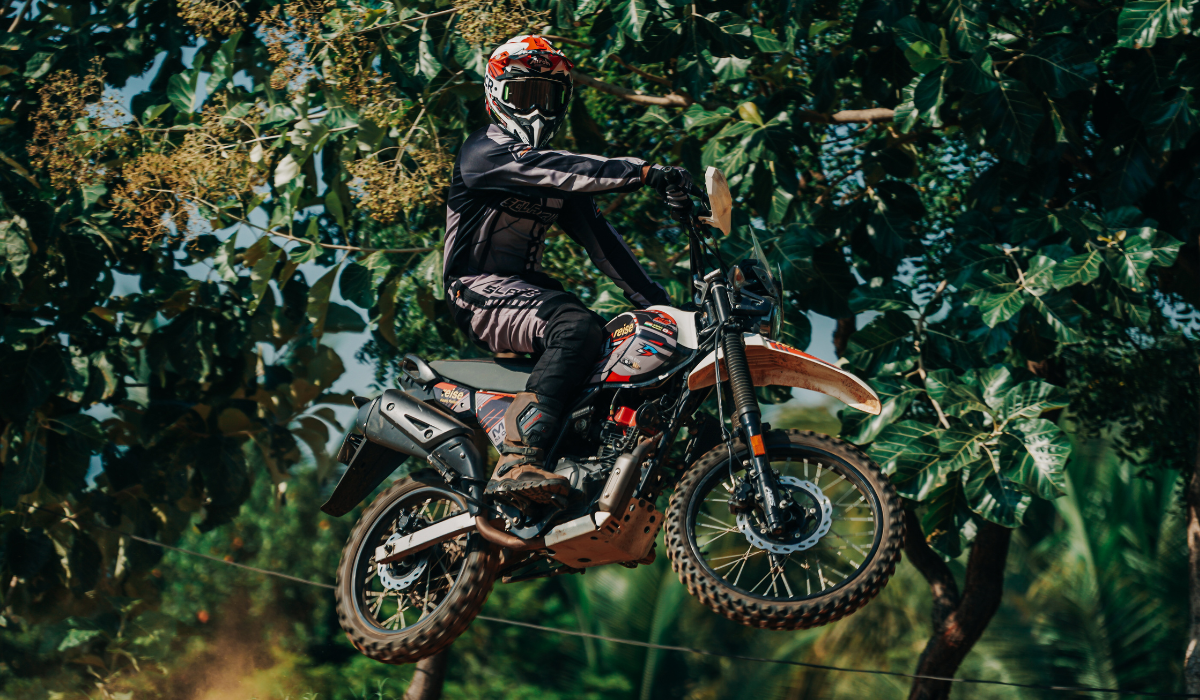
So you've got the bike. Or you're about to.
And now someone — a friend, a forum, a YouTube comment — has told you that you need to "gear up properly." Which is good advice. But then the same people start throwing around words like MIPS, CE Level 2, Cordura™ , waterproof membrane, and Gore-Tex, and suddenly buying gear feels as complicated as buying the motorcycle itself.
It doesn't have to be.
This guide covers the five pieces of gear every new rider needs, what to look for in each one, and why it matters — without drowning you in specs you don't need yet.
--------------------------------------------------------------------
Why Gear Matters More Than You Think
Here's the honest version that nobody leads with: most motorcycle accidents in India happen at low to moderate speeds. City traffic, unfamiliar corners, slippery roads after the first rain of the season.
You don't need to be doing 120kmph on a highway for gear to save you. A low-side at 40kmph in a t-shirt and jeans will take skin off your arms, hands, and knees. The same fall in proper gear is something you walk away from and talk about later.
Gear is not about being paranoid. It's about making sure a bad moment doesn't become a life-altering one.
With that said — let's get into it.
------------------------------------------------------------------
1. The Helmet — The One You Cannot Skip
If you buy nothing else, buy a good helmet. This is not negotiable.
The only piece of gear that directly determines whether you survive a crash.
Full-Face vs. Open-Face
As a new rider, get a full-face helmet.
An open-face helmet — the kind with no chin bar — leaves your face exposed. The chin is the single most common impact zone – accounting for up to 35% of all helmet impacts.
What Certification to Look For
In India, the legal minimum is ISI certification (IS 4151). That's the floor, not the target.
Better helmets carry international certifications:
-
DOT (US standard) — widely available, but can be ignored.
-
ECE 22.06 (European standard) — more rigorous test protocol than DOT, the current gold standard for road helmets.
-
SHARP/Snell/FIM ratings — independent testing programs that rate helmets. A useful cross-reference when comparing helmets.
Always look for ECE 22.06 if your budget allows.
Fit is Everything
A helmet that doesn't fit correctly doesn't protect correctly. It can rotate on impact, leave gaps, or simply come off.
When you try on a helmet:
-
It should feel snug — not painful, but with no movement when you try to shake it side to side or front to back.
-
The cheek pads should press gently against your cheeks.
-
There should be no pressure points on your forehead after a few minutes of wearing.
Helmets are sized by head circumference, but the shape of your head (round oval, intermediate oval, long oval) matters as much as the number. Try before you buy whenever possible.
Replace After a Drop
Helmet foam is designed to compress on impact and absorb energy — once. After a significant drop or crash, the foam may be compromised even if the shell looks fine. A helmet that's been in a crash should be replaced.

------------------------------------------------------------------
2. The Riding Jacket — Your armor Against the Road
A riding jacket does two things: protects your skin from abrasion if you slide, and protects your joints and spine from impact through built-in armor.
A regular jacket does neither of these things. Denim, leather fashion jackets, and windcheaters all look fine but offer minimal protection in a fall.
The Shell: What the Jacket is Made From
Textile jackets – They're made from synthetic fabrics like nylon or polyester woven at high density. They breathe reasonably well, handle rain better than leather, and work across seasons with a removable liner. Most of them include vent systems that you can open and close.
Mesh and textile hybrid jackets – They prioritise ventilation — great for Indian summers — but sacrifice some abrasion resistance.
Leather jackets offer excellent abrasion resistance but trap heat. Worth considering if you ride a sport bike or do track days, but for a new rider doing mixed city and highway riding, textile is more liveable.
Many modern jackets combine fabrics — textile panels on high-abrasion zones, mesh panels on the torso for airflow. This hybrid approach is often the most practical for Indian conditions.
The armor: CE Certification
Look inside the jacket at the shoulder, elbow, and back zones. There should be removable armor inserts.
The standard to look for is CE EN 1621. There are two levels:
-
CE Level 1 — meets minimum protection standards. Adequate for most riding.
-
CE Level 2 — higher energy absorption. Meaningfully better protection.
Check whether back and chest protectors are included. Many jackets come with a back and chest armor pocket but no insert. CE-rated back and chest protectors are worth buying separately if the jacket doesn't include them.
Fit in Riding Position
Try the jacket while sitting as if you're on the bike — leaning slightly forward, arms out. The sleeves should stay long enough to cover your wrists. The jacket shouldn't ride up at the back of the waist. The armor should sit directly over your elbows and shoulders, not above or below them.
At Solace, we offer jackets with CE certified protectors and abrasion resistance. The materials we use for the textile range from high tenacity polyester to Nylon and even specialized fabrics like Cordura™ and SuperFabric™ etc. The mesh we use is also highly abrasion resistant. Our armor partners are global brands like SAS-TEC, Safetech, Powertector and our home grown brand Soter.
--------------------------------------------------------------------
3. Riding Gloves — Your Hands Will Always Go Out First
Human instinct in a fall is to put your hands out. It's involuntary. Which means your hands will almost always be among the first things to contact the road.
Bare hands on tarmac at any speed is not a good outcome. Proper riding gloves protect your palms from abrasion, your knuckles from impact, and your wrist from the kind of hyperextension that breaks bones.
What to Look For
Palm protection — The palm takes the most abrasion in a slide. Look for reinforced leather (kangaroo leather is the most abrasion-resistant natural leather), Superfabric panels, or palm sliders. Palm sliders are hard plastic or TPU inserts on the base of the palm that allow your hand to slide forward on impact rather than gripping and stopping dead — this is what protects the scaphoid bone in your wrist.
We at Solace use TPU hard sliders or specialized scaphoid protection systems from Knox™
Knuckle protection — A hard shell or CE-rated knuckle protector over the back of the hand.
Wrist closure — A secure wrist closure, ideally a gauntlet style that extends over your jacket cuff, prevents the glove from separating from your jacket in a fall.
Finger reinforcement — The pinky finger and pinky-side of the hand hit the road early in a low-side. Superfabric or reinforced leather in this zone matters more than most buyers realize.
Short Cuff vs. Gauntlet
Short-cuff gloves look cleaner and are easier to put on, often combining hybrid mesh, spandex and leather chassis. Gauntlet gloves — which extend several inches past the wrist and strap over your jacket cuff — offer better protection and eliminate the gap between glove and jacket.
For new riders, gauntlet gloves are the safer choice. As you get more experience and develop a clearer sense of your riding style, you can make a more informed decision about the tradeoff.
Also look at the leather on the palm, remember full grain leather is the better choice compared to perforated leather when it comes to abrasion protection. Perforated leather will have holes or perforations.
We at Solace offer gloves in leather, vegan leather and a combination chassis with great abrasion resistance, CE certified pairs and high quality slider systems either designed by us in-house or from global brands like Knox™ --------------------------------------------------------------------
4. Riding Boots — Ankle Protection That's Easy to Overlook
Boots are the most overlooked piece of gear for new riders. They're also the piece most commonly replaced with "my regular shoes will be fine."
They won't. Here's why.
The ankle is extremely vulnerable in a motorcycle crash. It can be crushed, twisted, or impacted by the bike itself during a fall. Standard shoes and sneakers have no torsional rigidity — they offer almost no resistance to the ankle rolling or twisting under load.
Riding boots are built with ankle protection systems, reinforced toe boxes, heel cups, and soles designed to grip foot pegs and resist penetration.
What CE Certification Looks Like for Boots
The standard is EN 13634. It covers four zones — abrasion resistance, cut resistance, transverse rigidity (ankle roll protection), and ankle energy absorption — each rated at Level 1 or Level 2.
Look for boots that specify their EN 13634 ratings rather than just saying "CE certified." A boot with Level 2 transverse rigidity is meaningfully better at preventing ankle injuries than a Level 1 boot.
Riding Boots vs. Riding Shoes
Full riding boots extend above the ankle and offer more coverage. Riding shoes look closer to regular sneakers or casual footwear but have protective features built in — ankle armor, reinforced toe, protective sole.
For new riders: if you can live in full boots, wear them. If the style or practicality of full boots makes you likely to leave them at home, a proper pair of riding shoes worn consistently is better than boots sitting in your cupboard.
Protection you actually wear beats protection you own.
What Not to Wear
Regular leather shoes, sports shoes, and sandals all fail to protect the ankle in any meaningful way. Flip-flops on a motorcycle are genuinely dangerous — foot pegs can cause serious injury without a protective sole.
At Solace, we offer boots ranging from urban designs to adventure and highway touring or race-ready variants. We also include waterproof linings in some of our boots.
--------------------------------------------------------------------
5. Riding Pants — The Most Skipped Item, and the Most Regretted
New riders almost universally skip riding pants last.
Your legs contain some of the largest bones in your body and some of the most important joints — knees and hips. They're also the longest slide surfaces in a fall. Regular denim will abrade through in under a second at highway speeds. After that, it's skin on tarmac.
What Riding Pants Offer
Abrasion-resistant shell — Same logic as a jacket. High-denier textile, leather panels, or Kevlar lining over the knees and hips.
CE-rated knee armor — The knee is the most important impact zone on the lower body. CE Level 1 is the minimum; Level 2 is better. Check that knee armor sits correctly at your knee when you're seated on the bike — not above it.
Hip armor — Less commonly included at entry-level price points but worth looking for. The hip takes significant impact in a side fall.
Tailbone armor — Not so common bit of armor, but equally important. This one is an optional part and is not certified under EN 1621.
Connection to your jacket — Many riding pants have a zip connection at the waist to attach to a compatible jacket. This prevents the jacket from riding up in a crash, keeping your lower back and kidney area covered.
Riding Pants vs. Overpants
Dedicated riding pants look like regular trousers and can be worn day-to-day. Overpants are worn over your regular clothes — useful if you're commuting and need to arrive looking presentable. Both are valid; the choice depends on your lifestyle.
Riding Denims
These are specialized denims with reinforcements like Kevlar, Cordura™ denim fabric and so on. The fabric is designed to offer great abrasion resistance. These come bundled with armors too.
At Solace, we offer both riding pants and riding denims in varying price points along with CE Level 2 rated hip and knee/knee+shin armor.
--------------------------------------------------------------------
Building Your Kit: Where to Start
If budget is a constraint — and for most new riders it is — here's a sensible priority order:
1. Helmet — No compromise, no delay. Buy this first.
2. Gloves — Hands go out first, always. Buy these before your first ride.
3. Boots — Easy to deprioritise, important not to.
4. Jacket — Your largest surface area and the piece most visible to other riders. Buy early.
5. Riding Pants — Often last, but don't wait for a reason to wish you hadn't.
You don't need to buy everything at once. But you should have a plan to get there. Each piece you add meaningfully reduces the consequences of an off. The goal is to be fully geared before you start putting serious miles on the bike.
--------------------------------------------------------------------
One Last Thing
Good gear doesn't make you invincible. It makes the consequences of a mistake survivable.
The best riders in the world still go down occasionally. The difference between a story you tell at the next group ride and something much worse is often what they were wearing when it happened.
Gear up. Every ride.
Written by Solace Gear — riding gear built for Indian roads, Indian heat, and Indian riders who take their safety seriously.


